
The Complete Guide to Generating More Insurance Leads in 2027
Facebook advertising remains one of the most accessible ways for independent insurance agents to reach local prospects, generate leads, build name recognition, and stay visible throughout the year.
Facebook is not simply a platform for younger audiences. According to the Pew Research Center, 71% of U.S. adults use Facebook. That broad reach makes it especially valuable for agents selling Medicare, life insurance, final expense, ACA plans, supplemental health products, and other coverage designed for adults and families.
However, successful Facebook advertising in 2027 requires more than boosting a post and hoping people respond.
Agents need:
- A clearly defined audience
- A specific and relevant offer
- Professional advertising creative
- Accurate lead tracking
- Fast follow-up
- A repeatable testing process
- Compliance-aware messaging
This guide explains how insurance agents can build a practical Facebook advertising strategy without unnecessarily complicating the process.
Explore the PSM Marketing Hub or contact PSM Brokerage to learn how our team can help you build a more consistent marketing strategy.
Why Facebook Advertising Still Matters for Insurance Agents
Insurance is a relationship-driven business. Prospects want to understand who they are speaking with, whether that person is credible, and whether they can provide meaningful guidance.
Facebook gives agents several ways to build that familiarity.
An agent can use the platform to:
- Reach prospects within a defined service area
- Promote educational events or seminars
- Generate leads through instant forms
- Drive traffic to a landing page
- Promote downloadable guides
- Retarget people who previously visited a website
- Share educational videos and client-focused content
- Build local awareness before prospects need assistance
- Stay visible to existing clients and referral partners
This is especially useful because many insurance buyers do not respond the first time they see an agent’s message. They may see an advertisement, visit the agent’s website, read a review, watch a video, and then respond weeks later.
Facebook can support that entire journey.
Agents should also remember that advertising works best as part of a broader strategy. Your ads, website, reviews, follow-up process, and client communications should reinforce the same professional brand.
For additional ideas, review these local marketing strategies for insurance agents.
Start With One Audience, One Offer, and One Goal
One of the most common Facebook advertising mistakes is trying to promote too many services in one advertisement.
An ad that says an agency offers Medicare, life insurance, ACA coverage, annuities, dental, vision, final expense, and retirement planning does not give the prospect one clear reason to respond.
A stronger campaign begins with three decisions.
1. Choose One Audience
Examples include:
- People approaching Medicare eligibility
- Medicare beneficiaries who want an annual plan review
- Families interested in life insurance
- Retirees concerned about final expenses
- Self-employed individuals exploring health coverage
- Existing Medicare clients who may need hospital indemnity coverage
- Local residents interested in an educational Medicare seminar
The more clearly you define the audience, the easier it becomes to create relevant copy and imagery.
2. Choose One Offer
Your offer gives the prospect a reason to take action.
Possible insurance advertising offers include:
- Download a Medicare preparation guide
- Request an educational policy review
- Register for a local Medicare seminar
- Schedule a coverage consultation
- Receive a final expense planning checklist
- Request information about life insurance options
- Download a retirement healthcare planning worksheet
- Ask a licensed insurance agent a question
Avoid vague offers such as “Learn more about insurance.” A specific offer generally gives the prospect a clearer next step.
3. Choose One Campaign Goal
Decide what action you want the campaign to produce.
Your goal may be to:
- Generate completed lead forms
- Receive phone calls
- Book appointments
- Increase event registrations
- Drive qualified website visits
- Build a retargeting audience
- Promote an educational resource
Do not evaluate an appointment campaign solely by the number of clicks it receives. Likewise, do not judge an awareness campaign by the number of immediate sales it produces.
The campaign objective, offer, and measurement strategy should align.
Facebook Ad Formats Insurance Agents Can Use
Meta offers several campaign and ad formats. The right option depends on your audience, offer, budget, and follow-up capabilities.
Instant Form Lead Ads
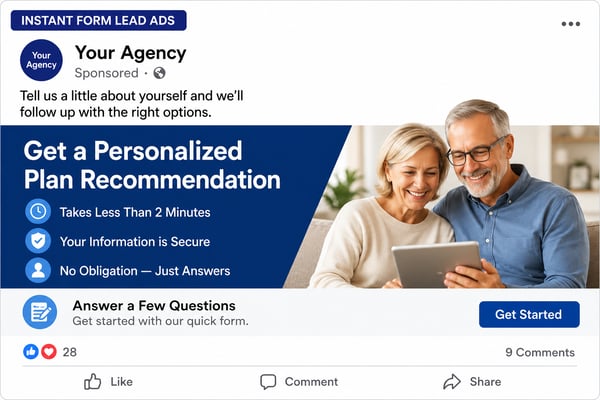
Facebook instant forms allow prospects to submit their contact information without leaving the platform.
These campaigns can work well because they reduce friction. According to Meta’s lead advertising guidance, instant forms can be used to generate and qualify leads by asking users to complete a form directly through the platform.
A practical insurance lead form could request:
- First and last name
- Phone number
- Email address
- ZIP code or county
- Preferred contact method
- General product interest
- Preferred time to be contacted
Keep the form concise, but include enough information to determine whether the prospect fits your market.
Adding one or two qualifying questions may reduce the total number of submissions, but it can also help improve lead quality.
For Medicare campaigns, agents must ensure that their lead collection, consent language, data handling, and follow-up procedures comply with applicable CMS requirements, carrier rules, privacy requirements, and state regulations.
Instant Form Lead Ad Sample:
Website Conversion Ads
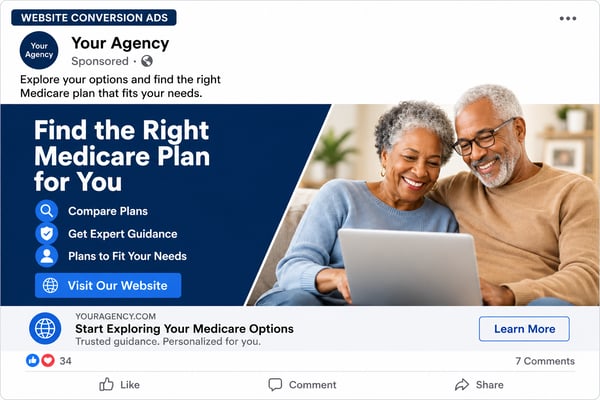
Website conversion campaigns send prospects to a dedicated landing page where they can complete a form, schedule an appointment, download a resource, or request additional information.
This approach gives agents more control over:
- Page content
- Disclosures
- Branding
- Form fields
- Appointment scheduling
- Analytics
- Retargeting
- CRM integration
The landing page should closely match the advertisement. Someone who clicks an ad about a Medicare checklist should not arrive on a generic agency homepage with numerous unrelated options.
Strong message alignment can improve conversion rates and reduce confusion.
Website Conversion Ad Sample:
Click-to-Call Ads
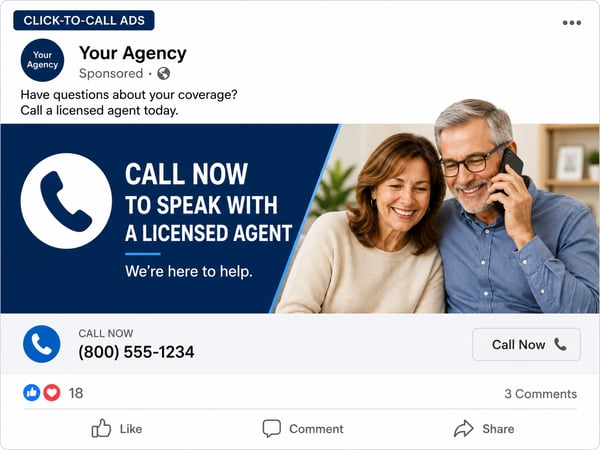
Click-to-call campaigns can be useful when the audience has an immediate question or prefers speaking directly with an agent.
They are best used when:
- A licensed agent is available to answer
- Calls can be tracked
- The ad runs during appropriate business hours
- The message creates a clear reason to call
- The team has a process for missed calls and voicemails
Sending calls to an unanswered phone line wastes advertising dollars and can damage trust.
Click-to-Call Ad Sample:
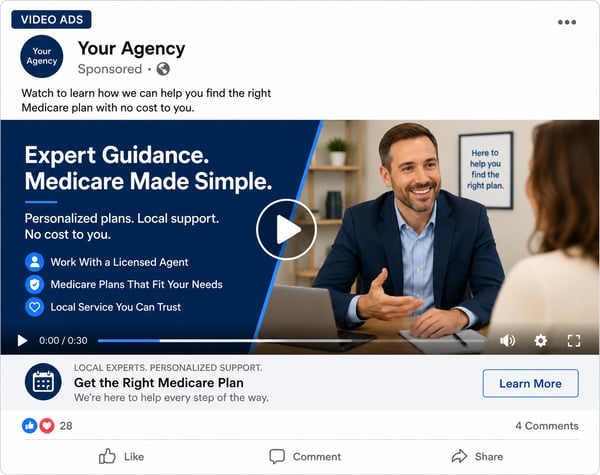
Video Ads
Short educational videos can help insurance agents build familiarity before asking for an appointment.
Useful video topics include:
- Three things to know before turning 65
- Common Medicare enrollment mistakes
- What a Medicare plan review includes
- Why life insurance may cost less than expected
- How final expense insurance works
- What self-employed individuals should know about health coverage
- Questions to ask before choosing an insurance agent
Videos should be concise and easy to understand. Include captions because many users watch social media videos without sound.
Avoid turning the video into a long product presentation. The goal is to capture attention, explain one concept, and provide a clear next step.
Video Ad Sample:
Event Promotion Ads
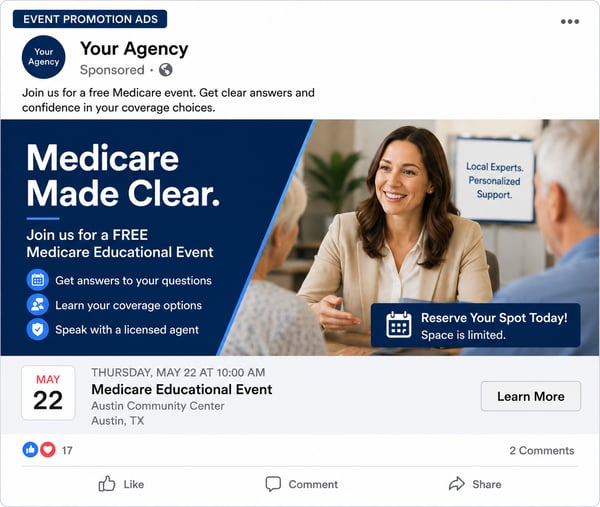
Facebook can help agents promote:
- Medicare educational events
- Community workshops
- Retirement planning presentations
- Customer appreciation events
- Local webinars
- New-to-Medicare classes
Event campaigns should clearly communicate:
- What attendees will learn
- Who the event is intended for
- The date and time
- The location
- Whether registration is required
- Whether the event is educational or sales-focused
Agents hosting Medicare events should review current CMS and carrier requirements before promoting or conducting the event.
For more guidance, read our article on hosting Medicare sales and educational events.
Event Promotion Ad Sample:
Retargeting Ads
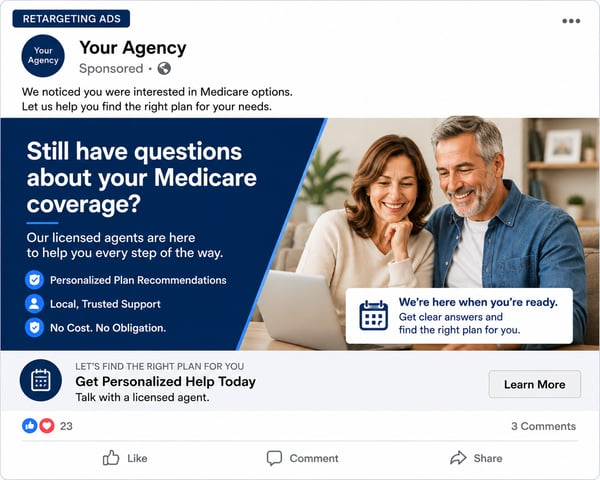
Retargeting allows agents to reconnect with people who previously interacted with their business.
Depending on available data and platform settings, this may include people who:
- Visited the agency website
- Watched a video
- Opened a lead form
- Engaged with a Facebook or Instagram account
- Visited a specific service page
- Previously entered an approved marketing audience
Retargeting is valuable because these individuals are already familiar with the agency.
A retargeting message might promote:
- A second educational resource
- An appointment opportunity
- An upcoming event
- A client testimonial
- A frequently asked question
- A reminder about an approaching enrollment period
Agents must use customer and prospect data responsibly and should only upload or use contact information when they have the necessary authorization and lawful basis to do so.
Retargeting Ad Sample:
Facebook Targeting for Insurance Agents in 2027
Meta’s targeting systems have evolved toward greater use of automation and broader delivery. Advertisers can still apply audience controls such as location, minimum age, language, and certain exclusions, while Meta’s systems may expand delivery based on audience suggestions and campaign performance.
Meta provides current details through its guidance on audience controls and audience suggestions.
Insurance agents should generally begin with the characteristics they know matter most.
Geographic Targeting
Only advertise where you are licensed and able to serve clients.
Depending on the campaign, agents may target:
- States
- Cities
- Counties
- ZIP codes
- A radius around an office or event location
- A defined multi-state service area
For local seminars, a tighter radius may be appropriate. For virtual consultations or telesales, a broader licensed territory may make more sense.
Meta provides additional information about location targeting in Ads Manager.
Age and Demographic Controls
Age can be relevant to certain insurance products, but agents should avoid assuming that age alone creates a strong audience.
For example, a Medicare campaign may focus on an age range associated with approaching eligibility. However, geography, offer, creative, timing, and lead qualification still matter.
Meta’s targeting capabilities and restrictions change periodically. Agents should review the current options available within Ads Manager rather than relying on an old targeting checklist.
Custom and Retargeting Audiences
Agents with established websites, client communication programs, or meaningful social engagement may be able to create stronger campaigns through custom audiences.
These can help an agency:
- Reconnect with website visitors
- Promote additional resources to engaged users
- Reach existing clients with appropriate communications
- Build modeled audiences based on qualified customer data
Before uploading a customer list, confirm that your privacy practices, permissions, platform terms, carrier requirements, and applicable regulations allow the intended use.
How to Create Better Insurance Ad Creative
An effective advertisement usually communicates one central idea within a few seconds.
It does not need to explain every feature of the product.
Use a Clear Headline
Examples include:
- Turning 65 Soon? Start With This Checklist
- Planning for Medicare Should Not Feel Overwhelming
- Is Your Life Insurance Coverage Keeping Up?
- Understand Your Final Expense Options
- Join Us for a Local Medicare Educational Event
- Get Answers From a Licensed Insurance Agent
Your headline should help the right prospect immediately recognize that the message applies to them.
Keep the Primary Text Focused
Effective ad copy typically includes:
- A recognizable concern or goal
- A brief explanation of the offer
- A clear action to take
For example:
“Preparing for Medicare can bring a lot of questions. Download our New-to-Medicare checklist to understand important timelines, coverage choices, and the steps to take before your eligibility date.”
Avoid long blocks of text, excessive punctuation, unrealistic promises, and unnecessary urgency.
Use Professional Visuals
Insurance advertising should look credible and approachable.
Effective creative may include:
- A clean branded graphic
- A professional photograph
- A simple checklist preview
- An event image
- A short educational video
- A recognizable local setting
- A client-approved testimonial graphic
- A clear illustration related to the topic
Avoid cluttered graphics containing paragraphs of text. The advertisement should earn attention, while the lead form or landing page provides the details.
Agents partnered with PSM Brokerage can use the PSM Marketing Hub to request customized marketing materials created by an in-house design team.
Test Meaningful Differences
Testing does not mean changing one word in the headline and expecting a major result.
A useful test compares meaningful variables, such as:
- Educational offer versus appointment offer
- Static image versus video
- Agent photo versus lifestyle image
- Instant form versus landing page
- Short form versus qualifying form
- Local message versus general message
- Benefit-driven headline versus problem-driven headline
Whenever possible, isolate the variable being tested. If you change the image, audience, offer, headline, form, and budget at the same time, you will not know what caused the performance difference.
Allow campaigns enough time and budget to generate useful data, but do not leave a clearly unsuccessful campaign running indefinitely.
Do Not Measure Success by Cost Per Lead Alone
A low-cost lead is not automatically a good lead.
Agents should monitor the complete path from advertisement to policy.
Important metrics may include:
- Cost per lead
- Contact rate
- Appointment rate
- Show rate
- Quote or presentation rate
- Application rate
- Cost per application
- Placement rate
- Revenue per lead
- Lead source by product
- Long-term client value
A campaign producing $8 leads may be less profitable than one producing $25 leads if the less expensive leads cannot be reached or rarely qualify.
Connecting advertising activity to an organized lead-management system helps agents understand what is producing real business.
PSM offers CRM solutions for insurance agents designed to help agents organize opportunities, improve follow-up, and manage a growing book of business.
Speed-to-Lead Can Determine Whether the Campaign Works
Generating the lead is only the first step.
Prospects may submit forms to more than one company, become distracted, forget why they responded, or lose interest quickly. A slow response can make an otherwise successful campaign appear unsuccessful.
Create a defined process for every new lead.
A basic follow-up sequence may include:
- An immediate confirmation message
- A prompt phone call
- A voicemail when the prospect does not answer
- A compliant text or email follow-up
- A second contact attempt later that day
- Additional follow-up over the next several days
- Long-term educational nurturing when appropriate
The message should reference the original offer.
For example:
“Hi, this is Jordan. You recently requested our New-to-Medicare checklist on Facebook. I wanted to make sure you received it and see whether you had any questions.”
That is more effective than opening with, “You filled out a form online.”
Learn more about how insurance agents can improve speed-to-lead and closing ratios.
Build Trust Before Asking for the Sale
Facebook users are usually not actively shopping in the same way as someone searching Google for a specific insurance product.
They may be interested, but they still need a reason to trust the agent.
Before launching ads, strengthen the credibility signals surrounding your campaign.
Review your:
- Facebook business page
- Agency website
- Google Business Profile
- Agent biography
- Contact information
- Online reviews
- Recent social media posts
- Licensing information
- Privacy policy
- Landing-page disclosures
Prospects frequently research a business before responding or answering the phone.
PSM’s guide to building an insurance agent trust stack explains how agents can strengthen credibility throughout the customer journey.
Positive reviews can also support advertising performance by giving prospects independent evidence that other people have had a good experience. Review our guide to Google reviews for insurance agents for practical ways to create a consistent review-request process.
Facebook Advertising Compliance for Medicare Agents
Medicare advertising requires additional care.
CMS regulates Medicare Advantage and Part D marketing, and agents must also follow applicable carrier, federal, state, licensing, privacy, and platform requirements.
CMS maintains its current Medicare communications and marketing guidance online.
Before launching a Medicare-related campaign, agents should confirm:
- Whether the advertisement requires carrier approval
- Whether required disclaimers are present
- Whether the advertisement could be considered misleading
- Whether benefits or savings claims are properly supported
- Whether the advertisement clearly identifies the advertiser
- Whether permission-to-contact language is sufficient
- Whether the lead form explains how data will be used
- Whether the landing page includes appropriate disclosures
- Whether the campaign represents plan availability accurately
- Whether call recording or other TPMO requirements apply
- Whether collected data may be shared with another organization
CMS has specifically addressed how TPMOs collect and share beneficiary data. Personal beneficiary data collected for Medicare marketing or enrollment generally may only be shared with another TPMO when the individual has provided prior express written consent for that sharing.
Avoid advertisements that:
- Imply an affiliation with Medicare or the federal government
- Use Medicare imagery in a misleading way
- Suggest that every recipient qualifies for a particular benefit
- Advertise unsupported savings
- Create artificial urgency
- Make broad claims without required context
- Obscure who will contact the consumer
- Collect information without clear consent language
Compliance should be reviewed before the campaign launches, not after leads begin arriving.
Common Facebook Advertising Mistakes
Insurance agents frequently struggle with Facebook ads for predictable reasons.
Boosting Every Post
Boosting can increase reach, but it does not replace a structured campaign with defined objectives, tracking, audiences, and conversion events.
Use Ads Manager when lead generation and measurable results are the goal.
Sending Traffic to the Homepage
A general homepage forces the prospect to search for the information promised in the advertisement.
Use a focused landing page whenever possible.
Asking for Too Much Information
Long forms can discourage prospects. Only request information needed to make the next step useful.
Following Up Too Slowly
A lead should enter a defined follow-up process immediately.
Changing Campaigns Too Frequently
Constant edits can prevent the campaign from gathering enough data to make informed decisions.
Using Generic Creative
Stock graphics that could belong to any agency do little to establish a recognizable local brand.
Treating Every Lead the Same
Different offers attract different levels of intent. A checklist download may require more nurturing than a direct appointment request.
Ignoring Existing Clients
Facebook is not only a new-business platform. Agents can use appropriate organic content and approved campaigns to remain visible to clients, encourage referrals, and support retention.
A Simple Facebook Advertising Plan for Insurance Agents
Agents do not need to launch ten campaigns at once.
Start with a manageable system.
Step 1: Select One Product or Market
Choose the segment most relevant to your current business goals.
Step 2: Create One Valuable Offer
Use a guide, checklist, seminar, review, consultation, or other relevant next step.
Step 3: Build the Campaign
Create:
- One audience
- Two or three meaningfully different ads
- One lead form or landing page
- One confirmation page
- One lead notification workflow
Step 4: Prepare Follow-Up Before Launching
Know who will call the lead, when the call will occur, what the opening script will be, and how additional attempts will be documented.
Step 5: Track Results Beyond the Form
Measure contact, appointments, applications, and placed business—not merely clicks and submissions.
Step 6: Improve One Variable at a Time
Use actual performance data to improve the offer, creative, form, audience, or follow-up process.
Turnkey Marketing Support Through the PSM Marketing Hub
Many independent agents understand the value of marketing but do not have the time, design experience, compliance knowledge, or internal staff required to create polished campaigns consistently.
That is where PSM Brokerage can help.
Agents partnered with PSM receive access to the PSM Marketing Hub, a turnkey marketing resource designed specifically for independent insurance agents.
The Marketing Hub can help agents create customized materials such as:
- Facebook and social media graphics
- Educational flyers
- Seminar invitations
- Direct-mail pieces
- Business cards
- Email campaign graphics
- Client-facing brochures
- Event signage
- Branded checklists
- Cross-selling materials
- Seasonal campaign assets
Materials can be customized with the agent’s:
- Name
- Agency name
- Logo
- Contact information
- Brand colors
- Website
- Approved call to action
The service is available at no cost to qualifying agents partnered with PSM Brokerage.
Instead of spending hours attempting to design advertising creative or paying an outside agency for every campaign, PSM agents can work with an experienced in-house marketing team that understands the insurance market.
The Marketing Hub is not limited to creating a single graphic. It can support a more complete marketing system that connects:
- Digital advertising
- Social media
- Email outreach
- Educational events
- Client retention
- Referral generation
- Cross-selling
- Local brand development
PSM also provides marketing automation resources to help agents create more consistent lead nurturing, client communication, retention, and cross-selling workflows.
Build a Facebook Strategy You Can Repeat
The most effective Facebook advertising strategy is not necessarily the most complicated.
It is the one an agency can execute, measure, and improve consistently.
Start with:
- One clearly defined audience
- One relevant offer
- One focused campaign
- Professional creative
- Accurate consent and compliance language
- Fast lead follow-up
- Complete performance tracking
Once that system works, expand it into additional products, audiences, geographic markets, and campaign types.
Facebook advertising will not replace good sales skills, strong client service, or a trusted local reputation. It can, however, help independent agents create more conversations and remain visible in a highly competitive market.
Get Marketing Support Built for Independent Agents
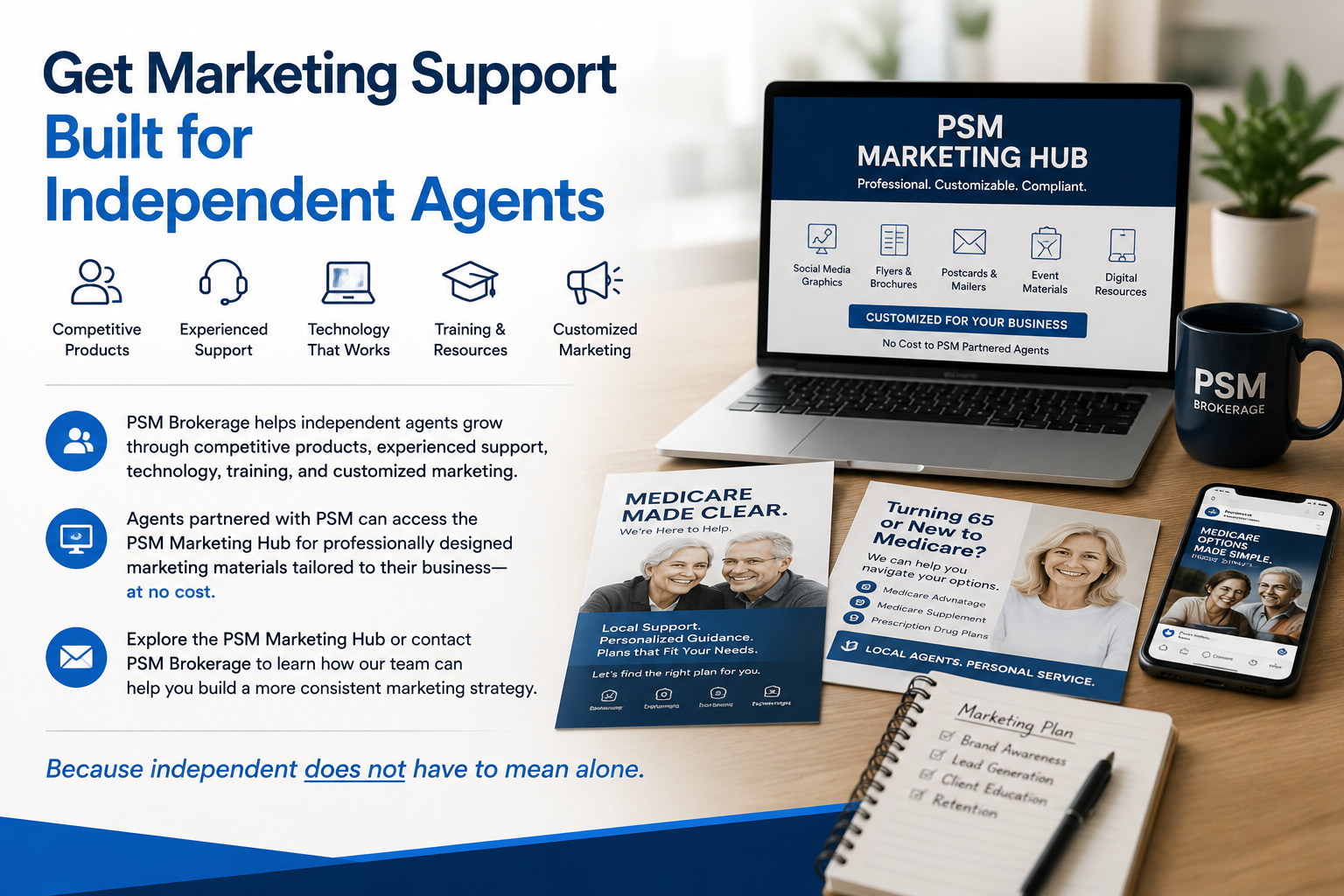
PSM Brokerage helps independent agents grow through competitive products, experienced support, technology, training, and customized marketing.
Agents partnered with PSM can access the PSM Marketing Hub for professionally designed marketing materials tailored to their business—at no cost.
Explore the PSM Marketing Hub or contact PSM Brokerage to learn how our team can help you build a more consistent marketing strategy.
Because independent does not have to mean alone.
Frequently Asked Questions
Do Facebook ads work for insurance agents?
Facebook ads can work for insurance agents when the campaign uses a defined audience, relevant offer, professional creative, prompt follow-up, and reliable tracking. Results depend heavily on the product, geographic market, advertising budget, lead form, and sales process.
How much should an insurance agent spend on Facebook ads?
There is no universal budget. Start with an amount that can generate enough leads or conversions to evaluate the campaign without putting unnecessary pressure on the business. A small local test may begin with a modest daily budget, while a multi-state campaign usually requires substantially more data and spending.
Should insurance agents use boosted posts or Ads Manager?
Boosted posts can support basic visibility and engagement. Ads Manager generally provides better controls for campaigns focused on lead generation, website conversions, retargeting, audience testing, and performance measurement.
Are Facebook leads good insurance leads?
Facebook leads vary in quality. Lead quality can be improved through a specific offer, accurate advertising copy, qualifying questions, clear expectations, immediate follow-up, and consistent nurturing. Evaluate leads based on appointments and placed business rather than cost per form submission alone.
What type of Facebook ad works best for Medicare agents?
Instant-form campaigns, educational guide offers, video ads, seminar promotions, and appointment campaigns can all work. The best format depends on the market and follow-up process. Medicare agents must ensure that all advertising, lead collection, consent, and outreach comply with current CMS and carrier requirements.
Can insurance agents target people turning 65 on Facebook?
Meta may allow advertisers to use age-related audience controls and suggestions, but the exact options available can change. Agents should review current Ads Manager settings and avoid relying solely on age. Location, offer, creative, timing, and lead qualification are also important.
Does PSM create Facebook advertising materials for agents?
Yes. Agents partnered with PSM Brokerage can request customized social media graphics and other marketing materials through the PSM Marketing Hub. The service is available at no cost to qualifying PSM agents.
Sources
- Pew Research Center: Americans’ Social Media Use 2025
- Meta Business Help Center: Lead Ads With Instant Forms
- Meta Business Help Center: Audience Controls and Suggestions
- Meta Business Help Center: Location Targeting
- CMS: Medicare Communications and Marketing Guidelines
- CMS: Contract Year 2025 Medicare Advantage and Part D Final Rule
Take Your Marketing to the Next Level with PSM Marketing Hub
Ready to create high-performing Facebook Ads but need a little guidance? The PSM Marketing Hub has you covered. With tools, resources, and expert advice tailored for insurance agents, we’ll help you craft campaigns that drive results.
Contact PSM today and let us help you transform your marketing strategy!
Topics:



.png?width=1536&height=1024&name=996d14f4-7288-418b-966e-b89d57c32719%20(1).png)


.png?width=1672&height=941&name=download%20(2).png)
.png?width=1774&height=887&name=download%20(5).png)
.png?width=1536&height=1024&name=download%20(1).png)


%20(1200%20x%20628%20px)%20-%202026-07-08T112014.415-1.png?width=600&height=338&name=Marketing%20Hub%20CTA%20Image%20(600%20x%20338%20px)%20(1200%20x%20628%20px)%20-%202026-07-08T112014.415-1.png)

%20(1200%20x%20628%20px)%20-%202026-08-25T114626.888.png?width=800&height=451&name=Marketing%20Hub%20CTA%20Image%20(600%20x%20338%20px)%20(1200%20x%20628%20px)%20-%202026-08-25T114626.888.png)
%20(1200%20x%20628%20px)%20-%202026-08-25T111854.607.png?width=800&height=451&name=Marketing%20Hub%20CTA%20Image%20(600%20x%20338%20px)%20(1200%20x%20628%20px)%20-%202026-08-25T111854.607.png)
%20(1200%20x%20628%20px)%20-%202026-08-19T141856.652.png?width=600&height=338&name=Marketing%20Hub%20CTA%20Image%20(600%20x%20338%20px)%20(1200%20x%20628%20px)%20-%202026-08-19T141856.652.png)

%20(1200%20x%20628%20px)%20-%202026-08-17T164205.652.png?width=600&height=338&name=Marketing%20Hub%20CTA%20Image%20(600%20x%20338%20px)%20(1200%20x%20628%20px)%20-%202026-08-17T164205.652.png)
