
%20(1200%20x%20628%20px)%20(91).png?width=600&height=338&name=Marketing%20Hub%20CTA%20Image%20(600%20x%20338%20px)%20(1200%20x%20628%20px)%20(91).png)
The Gap Clients Rarely See Until It Matters
One thing we’ve learned from working closely with agents is that most clients underestimate the out-of-pocket costs associated with hospitalization.
Deductibles add up quickly.
Daily hospital copays stack.
Time away from work creates financial stress that medical coverage alone doesn’t address.
Hospital indemnity insurance plans are designed to help with exactly this scenario. They pay fixed cash benefits directly to the policyholder when a covered hospital event occurs, giving clients flexibility when they need it most.
When agents explain the gap first, hospital indemnity stops sounding optional and starts sounding practical.
Clients don’t buy hospital indemnity because it’s “extra.”
They buy it because it helps them stay financially steady during a hospital stay.
Why Hospital Indemnity Is a Core Supplemental Product
Over time, we’ve watched hospital indemnity insurance become a reliable part of many agents’ portfolios—not because it’s flashy, but because it works.
It’s:
-
Straightforward to explain
-
Available year-round
-
Easy to pair with Medicare Advantage, ACA plans, and employer coverage
And most importantly, clients understand it. Cash benefits. Paid directly to them. Used however they choose. That simplicity matters.
Who Hospital Indemnity Insurance Works Best For
Hospital indemnity insurance isn’t for everyone, and agents who are most successful with it understand who it fits best.
We consistently see strong results when it’s positioned for:
-
Medicare Advantage clients with daily hospital copays
-
ACA enrollees facing high deductibles
-
Individuals with limited employer-sponsored coverage
-
Self-employed clients without a financial cushion
When the financial exposure is real, the value is clear.
Hospital indemnity works best when the client already feels some financial risk. Awareness creates understanding. Understanding creates confidence.
How to Introduce Hospital Indemnity Naturally
The most effective agents don’t lead with a product pitch.
They start with a question.
Something simple, like:
“If you were hospitalized for a few days, how comfortable would you feel with the out-of-pocket costs?”
From there, the explanation stays clean and honest:
-
When benefits pay
-
How much they pay
-
How the money can be used
No technical jargon. No pressure.
Just clarity.
A Simple Scenario That Changes the Conversation
One of the most effective tools agents use is a basic, real-world example.
A short hospital stay.
A daily copay.
A few unexpected expenses.
Then they pause.
Letting the client do the math themselves often says more than any sales script ever could.
The best sales conversations don’t feel like selling.
They feel like helping someone think through a real situation.
Why Hospital Indemnity Also Makes Sense for Your Business
In addition to client protection, hospital indemnity insurance provides practical business benefits for agents.
It supports:
-
Year-round sales activity
-
Stronger client retention
-
Meaningful follow-up conversations
-
Additional revenue without added complexity
It’s not meant to replace core products. It complements them.
What We’d Tell Any Agent Considering Hospital Indemnity
If you’re thinking about adding hospital indemnity insurance to your portfolio, our advice is simple:
Don’t overcomplicate it.
Learn how the product works.
Be clear about who it’s for.
Keep the conversation honest and compliant.
When positioned correctly, hospital indemnity feels like good guidance, not an upsell.
Trust is built when clients feel informed, not sold to.
Hospital indemnity fits naturally into that kind of conversation.
A Tool Our Agents Use in Real Conversations
One of the simplest ways to make hospital indemnity discussions feel natural is to slow the conversation down and focus on the client’s situation first.
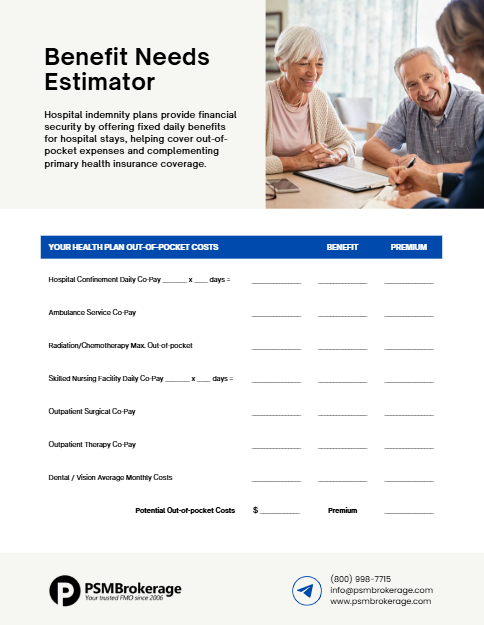
That’s why we created a Client Needs Worksheet our agents use to guide these discussions. It helps organize key questions around coverage, out-of-pocket exposure, and financial comfort, so conversations stay clear, compliant, and client-focused.
The worksheet isn’t a sales script. It’s a framework that helps uncover whether hospital indemnity insurance actually makes sense for the client.
If you’d like to use it in your own conversations, you can download it below and adapt it to your process.
👉 Download the Hospital Indemnity Client Needs Worksheet
A Final Thought
The most valuable insurance products are often the quiet ones—the ones clients don’t fully appreciate until they truly need them.
Hospital indemnity insurance has consistently proven to be one of those solutions, both for clients and for the agents who serve them.
That’s why we continue to support it as part of a thoughtful, well-rounded product strategy.


%20(1200%20x%20628%20px)%20(25).png?width=600&height=338&name=Marketing%20Hub%20CTA%20Image%20(600%20x%20338%20px)%20(1200%20x%20628%20px)%20(25).png)
%20(1200%20x%20628%20px)%20(13).png?width=600&height=338&name=Marketing%20Hub%20CTA%20Image%20(600%20x%20338%20px)%20(1200%20x%20628%20px)%20(13).png)