
Federal oversight of Medicaid program integrity is becoming a bigger issue in 2026, and insurance agents should be paying attention.
While most independent agents are not directly involved in Medicaid administration, changes to Medicaid oversight can still affect the broader health insurance conversation. For agents who work with Medicare, ACA, dual-eligible clients, low-income beneficiaries, or families transitioning between coverage options, understanding the direction of federal scrutiny can help create better client conversations and stronger referral guidance.
A recent KFF article, “What to Know About Recent Federal Actions Involving State Medicaid Program Integrity,” outlines several federal actions involving Medicaid fraud, waste, abuse, provider oversight, state funding reviews, and program integrity enforcement.
What the KFF Article Covers
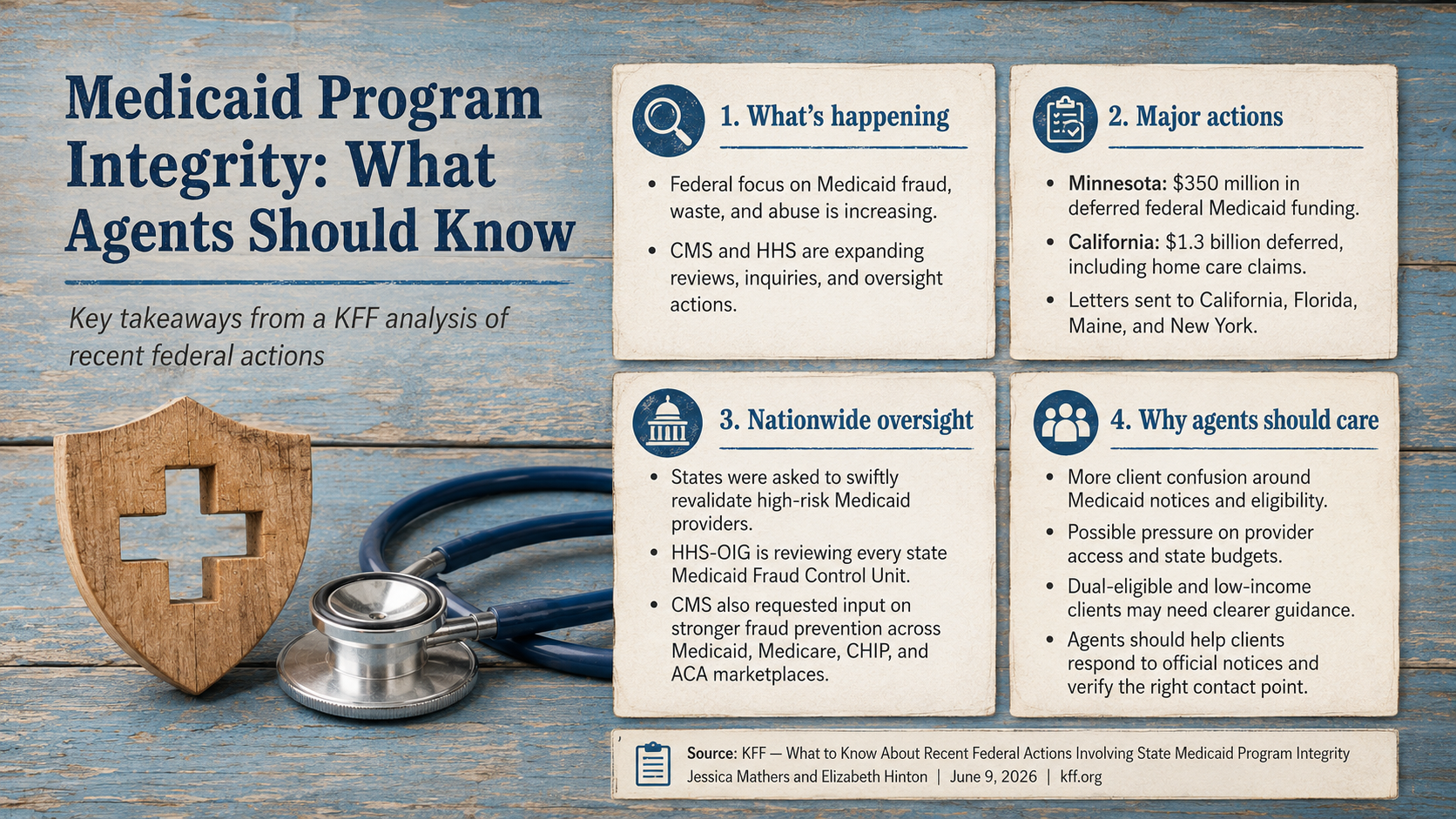
KFF explains that the Trump Administration has increased its focus on fraud, waste, and abuse across federal health programs, including Medicaid, Medicare, CHIP, and ACA Marketplaces.
According to KFF, recent federal actions include:
- CMS payment deferrals involving Medicaid expenditures in Minnesota and California
- CMS inquiries into Medicaid program integrity in California, Florida, Maine, and New York
- A nationwide CMS request for states to revalidate high-risk Medicaid providers
- Increased HHS-OIG scrutiny of state Medicaid Fraud Control Units
- A CMS Request for Information called the CRUSH initiative, focused on strengthening program integrity across CMS programs
The key takeaway is simple: federal agencies are putting more pressure on states to prove that Medicaid dollars are being spent properly and that provider enrollment, billing, and oversight processes are strong enough to prevent abuse.
Why This Matters to Insurance Agents
Insurance agents do not need to become Medicaid policy experts. But agents do need to understand when federal or state-level Medicaid changes may affect consumers.
Many Medicare agents work with clients who are dual eligible, meaning they qualify for both Medicare and Medicaid. ACA agents may also encounter individuals who move between Medicaid and Marketplace coverage depending on income, eligibility, or state renewal rules.
When Medicaid oversight increases, states may face more administrative pressure. That can lead to more reviews, more documentation requirements, more eligibility checks, and more confusion for consumers.
For agents, this creates an opportunity to be a calm, informed resource.
Clients may not understand the difference between Medicaid, Medicare, Medicare Advantage, Extra Help, DSNP plans, ACA subsidies, or state eligibility rules. When program integrity changes make headlines, consumers may become concerned about whether their benefits are safe, whether they need to take action, or whether they qualify for other coverage.
Agents who understand the basics can help clients ask the right questions and avoid making rushed decisions.
Program Integrity Does Not Automatically Mean Fraud
One important point from the KFF article is that Medicaid fraud is difficult to measure precisely. KFF notes that there are no reliable measures of fraud against Medicaid because fraud can only be confirmed after it is identified, investigated, and resolved.
That matters because increased spending or higher use of certain services does not always mean fraud is occurring.
Some states have argued that higher Medicaid spending reflects policy decisions designed to expand access to services such as home care or behavioral health. In other words, program growth and improper activity are not the same thing.
For agents, this is an important distinction. When discussing Medicaid-related news with clients or community partners, avoid overstating what federal actions mean. A review, inquiry, or funding deferral does not automatically mean wrongdoing has been proven.
A compliant, professional explanation should sound more like this:
“Federal agencies are reviewing certain Medicaid spending and provider oversight processes. That does not necessarily mean benefits are changing for everyone, but it is a reminder to stay informed and respond quickly to any official notices.”
Provider Revalidation Is a Key Area to Watch
KFF highlights that CMS has asked states to revalidate high-risk Medicaid providers and develop broader provider revalidation strategies.
Provider revalidation means confirming that providers enrolled in Medicaid still meet applicable requirements. This can include verifying licenses, checking databases, conducting site visits, or applying additional screening based on provider risk level.
Why should agents care?
Because provider oversight can affect access.
If certain provider categories face more scrutiny, some consumers may experience confusion about which providers are approved, active, or available through Medicaid-related programs. This may be especially relevant for consumers who rely on home care, behavioral health services, non-emergency medical transportation, or other services that federal agencies may view as higher risk.
Agents should not advise clients on Medicaid provider eligibility unless they are qualified and authorized to do so. But they can encourage clients to verify provider participation directly with the state Medicaid agency, plan, or provider office before receiving services.
Dual-Eligible Clients May Have More Questions
Medicare agents should pay particular attention to how Medicaid program integrity actions may affect dual-eligible beneficiaries.
Dual-eligible clients often have more complex coverage situations. They may rely on Medicare, Medicaid, Extra Help, Medicare Savings Programs, prescription drug assistance, and sometimes DSNP plans.
If a client receives a Medicaid renewal notice, provider notice, eligibility request, or plan communication, they may not know what it means. They may ignore it, misread it, or assume their Medicare coverage is being cancelled.
Agents can add value by helping clients understand the difference between:
- Medicare plan communications
- Medicaid eligibility notices
- Extra Help or LIS information
- DSNP eligibility requirements
- State Medicaid renewal requests
- Provider network or service authorization notices
The agent’s role is not to replace the state Medicaid office. The role is to help the client slow down, identify the source of the notice, and contact the right organization.
What Agents Should Do Now
This is not a reason for agents to panic. It is a reason to become more aware.
Here are a few practical steps agents can take:
- Stay alert to Medicaid-related changes in your state.
Federal Medicaid oversight may look different from one state to another. Agents should follow updates from state Medicaid agencies, carriers, and trusted industry resources. - Be careful with client language.
Do not suggest that Medicaid benefits are being cut or that fraud has occurred unless there is a confirmed, client-specific reason to say so. - Document coverage conversations.
When working with Medicare or ACA clients who mention Medicaid, Extra Help, or state assistance, keep clear notes about what was discussed and what resources were provided. - Encourage clients to respond to official notices.
Many coverage issues begin when consumers ignore mail, renewal requests, or documentation deadlines. - Know when to refer.
Medicaid eligibility and state program questions may need to be directed to the state Medicaid office, carrier, SHIP counselor, caseworker, or another qualified resource.
The Bigger Picture
The KFF article makes clear that Medicaid program integrity will remain an active federal and state issue. CMS and HHS-OIG are looking more closely at state processes, provider oversight, payment claims, and fraud-control systems.
For insurance agents, the biggest takeaway is not that Medicaid rules are suddenly changing overnight. The bigger takeaway is that health coverage is becoming more administratively complex.
That complexity creates confusion for consumers.
Agents who stay informed can help clients navigate that confusion with more confidence. Whether the conversation involves Medicare, ACA coverage, Medicaid eligibility, Extra Help, or dual-eligible plan options, agents who understand the broader policy environment are better positioned to serve as trusted local resources.
Program integrity may sound like a government operations issue. But for consumers, it can quickly become a coverage question.
That is where a knowledgeable agent can make a real difference.
%20(1200%20x%20628%20px)%20-%202026-04-08T093004.660.png?width=600&height=338&name=Marketing%20Hub%20CTA%20Image%20(600%20x%20338%20px)%20(1200%20x%20628%20px)%20-%202026-04-08T093004.660.png)
%20(1200%20x%20628%20px)%20-%202026-04-08T105525.606.png?width=600&height=338&name=Marketing%20Hub%20CTA%20Image%20(600%20x%20338%20px)%20(1200%20x%20628%20px)%20-%202026-04-08T105525.606.png)
%20(1200%20x%20628%20px)%20-%202026-01-28T104734.950.png?width=600&height=338&name=Marketing%20Hub%20CTA%20Image%20(600%20x%20338%20px)%20(1200%20x%20628%20px)%20-%202026-01-28T104734.950.png)
%20(1200%20x%20628%20px)%20(92).png?width=600&height=338&name=Marketing%20Hub%20CTA%20Image%20(600%20x%20338%20px)%20(1200%20x%20628%20px)%20(92).png)
%20(1200%20x%20628%20px)%20(72).png?width=600&height=338&name=Marketing%20Hub%20CTA%20Image%20(600%20x%20338%20px)%20(1200%20x%20628%20px)%20(72).png)
%20(1200%20x%20628%20px)%20(49)-1.png?width=600&height=338&name=Marketing%20Hub%20CTA%20Image%20(600%20x%20338%20px)%20(1200%20x%20628%20px)%20(49)-1.png)